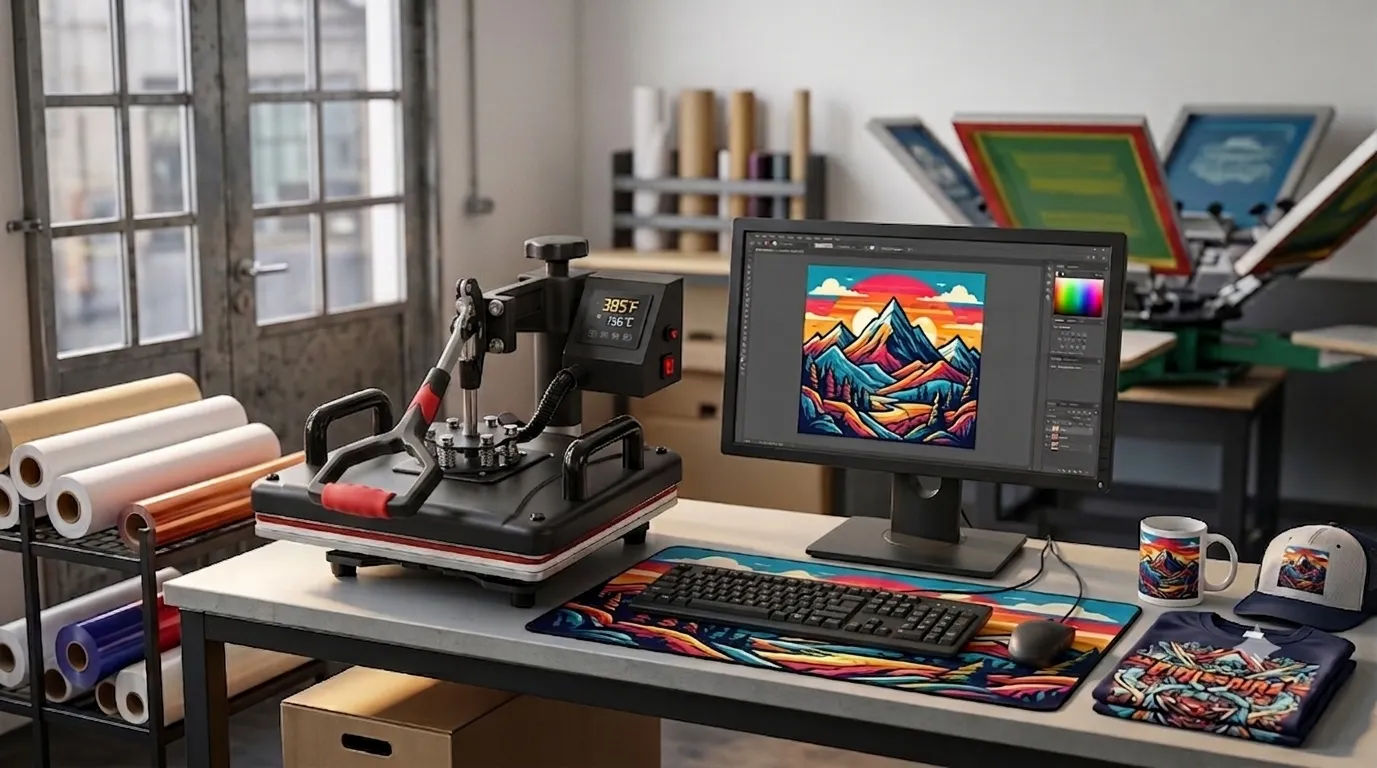
The customization market in India isn’t just growing—it’s fully saturated in nearly every local tier-1, tier-2, and tier-3 town. Walk down almost any commercial market, and you will find someone offering customized corporate gifts, local event T-shirts, or personalized mug printing.
Does that mean you’ve missed the boat? Not at all.
Even though service providers are flooding the market, customer demand is at an all-time high. From local college events and regional corporate branding to micro-influencer merch and personalized gifts, the volume of orders being generated daily is massive. You can completely build a profitable market footprint in your local hub and eventually expand to supply national or global clients.
However, breaking into the customized printing space in 2026 relies on two specific levers: technical edge and operational speed.
If you are looking to get off the ground with a lean setup, minimal capital, and high execution speed, here is your step-by-step roadmap.
1. The Core Hardware Setup (Starting Under ₹1 Lakh)
Surprisingly, the physical equipment used to kickstart a customized product line hasn’t changed dramatically over the last few years. You don’t need a multi-million-rupee industrial floor to begin. You only need three core setup items to deliver your first batch of products.
Core Print Shop Toolkit
- Sublimation Printer: Epson L-series loaded with specialized sublimation ink
- 5-in-1 Combo Heat Press Machine: Handles flat and cylindrical transfer surfaces
- Editing Workstation: PC or laptop equipped with standard vector/raster editing software
A. The 5-in-1 Heat Press Machine
This is the workhorse of your entire operational setup. A heat press applies high, uniform thermal energy and surface pressure to infuse sublimation ink directly into poly-coated substrates or fabric fibers. A standard 5-in-1 combo attachment setup will allow you to handle flat surfaces (T-shirts, mousepads, keychains, aluminum plates) as well as cylindrical items (mugs, bottles) and curved caps.
B. A Dedicated Sublimation Printer
While advanced techniques like Direct-to-Film (DTF), Screen Printing, Direct-to-Garment (DTG), and UV Printing have distinct advantages for heavy volume, sublimation printing remains the absolute king for beginners.
- Why Sublimation? It has a negligible learning curve, cheap consumable costs, fast production speeds, and immense flexibility.
- Product Range: Sublimation works seamlessly on any product featuring a polymer base or polyester coating including customized T-shirts, coffee mugs, XL desk mats, promotional caps, and framed items.
C. A Functional Computer & Editing Workflow
You do not need a liquid-cooled workstation to manage graphic assets. A standard, budget-friendly desktop or laptop can power your operational backend.
- While mobile apps like PicsArt work for casual edits, professional software is essential for scalable prepress work.
- Industry standards like Adobe Photoshop or Illustrator remain unmatched for handling color profiles, CMYK conversions, and vector sizing without quality loss.
2. Supply Chain: Locking in Reliable Raw Material Partners
Once your equipment is set up, your success hinges on sourcing quality blanks at wholesale pricing.
Supply Chain Flow
Raw Material Vendors: Sourcing blank polymer mugs, high-GSM poly-blend T-shirts, and substrates.
In-House Print Shop: Executing custom sublimation printing and high-temp heat transfer.
End Customer Delivery: Fulfilling bulk B2B corporate orders and individual direct-to-consumer (D2C) retail sales.
Before taking on client orders:
- Conduct hands-on outreach with local, regional, and national blank vendors.
- Request sample packs of polymer-coated mugs, high-GSM polyester/poly-cotton blend T-shirts, and raw blank substrates.
- Stress-test material durability: Check for coating uniformity on mugs and wash-resistance on apparel.
Finding the right supplier is an art form in itself—we’ll be breaking down a dedicated vendor selection framework in an upcoming post.
3. The 2026 Shift: Building Instant Digital Authority
If the equipment and core manufacturing techniques are similar to what existed five years ago, what actually changed in 2026?
The Difference: Modern clients look at 5 to 10 vendors simultaneously within seconds. Production capacity is no longer your sole differentiator ; discoverability, response time, and digital authority are.
If customers can’t verify your work online instantly, you lose the deal to a competitor who maintains an active footprint.
Step A: Free Directory Listing (Day-1 Must-Haves)
Before spending money on paid advertising, secure your organic business listings across foundational directories:
- IndiaMART: Set up a detailed vendor profile listing your wholesale/bulk services. It acts as a massive inbound lead magnet for regional B2B orders.
- Google Business Profile (formerly Google My Business): Essential for capturing localized foot traffic, local map searches, customer reviews, and immediate trust verification.
- Secondary Platforms: Register on trade directories such as JustDial, TradeIndia, and relevant regional business portals.
Step B: Multi-Channel Outreach & Social Presence
- Instagram & Meta Ecosystem: The customization sector relies heavily on visual proof. Maintain an active Instagram handle showcasing short-form video content (Reels) of your printing process, finished orders, and client unboxing moments.
- Meta Business Suite: Connect your Instagram and Facebook pages inside Meta Business Suite to manage customer queries, track DMs, and run target-located ads.
Step C: Developing a Brand Website (Highly Recommended)
While starting out on marketplace profiles gets you moving quickly, launching a dedicated, self-owned website gives you total control over branding.
- Building and hosting a web store is faster and cheaper today than ever before.
- A clean catalog site with structured product pages builds immense corporate client trust, improves search visibility, and gives you a long-term asset to scale direct-to-consumer (D2C) retail.
Step D: AI Discoverability
Buyers today frequently search for local vendors using conversational AI assistants (such as Google Gemini, ChatGPT, and SearchGPT).
- Ensuring your business name, address, product offerings, and customer reviews are clearly indexed across Google Maps, local directories, and social platforms increases the chances that AI tools recommend your business when potential clients query “Best custom printing shop near me” or *”Custom corporate bulk mug suppliers in [City].” *
Summary Checklist: Your Launch Plan
| Phase | Core Objective | Key Action Items |
| Phase 1: Hardware | Equipment Setup | Acquire 5-in-1 Heat Press, Sublimation Printer, and Vector/Raster Editing Tools. |
| Phase 2: Supply Chain | Raw Sourcing | Test material samples for polymer mugs, desk mats, and apparel; lock in wholesale rates. |
| Phase 3: Directory Setup | Free Local SEO | Create and verify listings on IndiaMART, Google Business Profile, and JustDial. |
| Phase 4: Outreach | Digital Presence | Set up Instagram & Facebook via Meta Business Suite; post process reels daily. |
| Phase 5: Scale | Brand Equity | Launch a dedicated web store to capture direct-to-consumer & high-margin B2B deals. |
Starting a customized printing enterprise in 2026 doesn’t require complex overhead or massive initial investment. With under ₹1 Lakh in core equipment, high-quality blank suppliers, and a focused local SEO & outreach strategy, you can launch your brand and start landing orders right out of the gate.