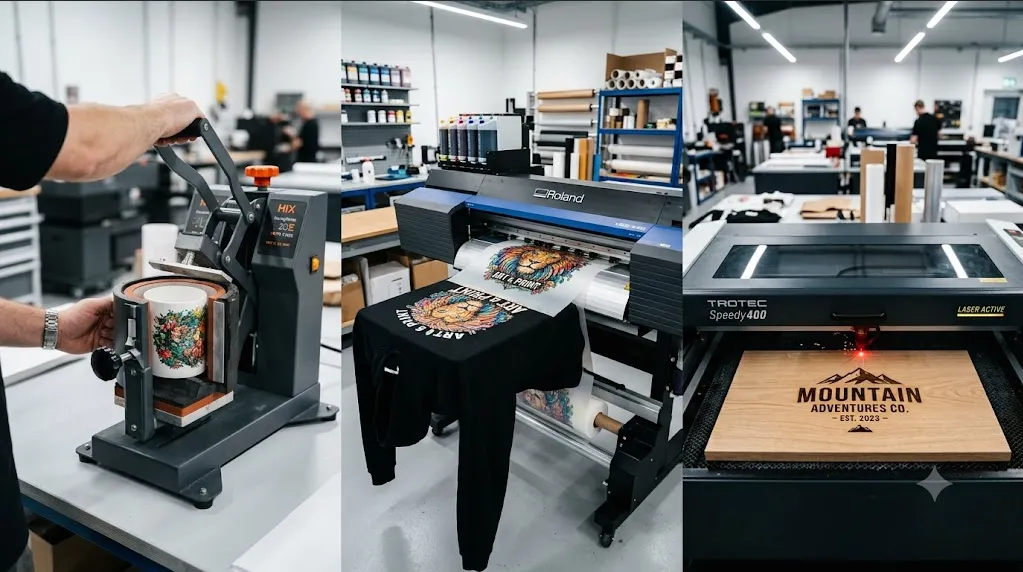
When entering the customization and merchandise industry, choosing the right printing technology is the single most critical decision for your production pipeline. While consumer inkjets and desktop laser printers handle standard paperwork, transferring durable, vivid graphics onto apparel, ceramic, metal, and synthetic substrates requires specialized industrial printing equipment and chemical ink formulations.
Whether you are launching a Direct-to-Consumer (D2C) brand, fulfilling corporate B2B orders, or sourcing merch for an event, understanding the mechanics, costs, and limitations of each printing method will save you time and capital.
Here is a breakdown of the leading commercial printing technologies powering the modern merchandise market.
1. Sublimation Printing: The Versatile Undisputed King
Sublimation printing remains the backbone of the custom gifting and promotional products industry due to its unparalleled product range, low initial setup cost, and permanent print durability.
🔄 Sublimation Printing Process
Step 1: Digital Artwork Creation
Step 2: Printed on Transfer Paper via Sublimation Ink
Step 3: Exposed to High Heat & Uniform Pressure (~200°C)
Step 4: Ink Gaseously Infuses Directly into Poly-Coated Substrate
How It Works
Sublimation uses specialized dye-sublimation inks containing disperse dyes. Artwork is digitally printed in reverse onto dedicated sublimation transfer paper. The printed sheet is placed against the item and loaded into a 5-in-1 or flatbed heat press.
When exposed to high heat (~180°C to 200°C) and uniform mechanical pressure, the ink undergoes a phase transition: it converts directly from a solid dye to a gas without passing through a liquid state. Simultaneously, the polymer molecules on the item’s surface expand, opening tiny pores. The gaseous dye penetrates these open pores. Once cooled, the polymer structure seals shut, trapping the dye permanently inside the material rather than layering it on top.
Requirements & Limitations
Polyester Coating Essential: The core chemical restriction of sublimation is that it requires a polyester (poly-coated) surface. It bonds seamlessly with 100% polyester apparel, poly-blend fabrics, and hard goods (ceramic mugs, mousepads, aluminum plates, caps, phone cases) that have an applied polymer coating.
Light Substrates Only: Sublimation dye has no white ink capability. Because the ink fuses directly into the fibers, it relies on a light-colored or white background to reflect color accurately. Printing on dark or black fabrics is chemically impossible with pure sublimation.
Why It Dominates
Permanent Durability: Because the dye becomes part of the substrate itself, the print cannot crack, peel, fade, or wash off. It literally outlasts the shelf life of the underlying item.
Cost-Efficiency: Modified desktop printers loaded with sublimation ink paired with a basic heat press keep the initial hardware setup well under ₹1 Lakh.
Need high-durability custom gear? Explore Designing Galaxy’s Custom Sublimation Mug Printing and our lightweight Custom T-Shirt Printing Services to see how permanent sublimation graphics look on finished products.
2. Screen Printing: The High-Volume Monochromatic Workhorse
Screen printing (serigraphy) is one of the oldest printing methodologies, remaining dominant for mass-producing high-volume apparel.
🎨 Screen Printing Mechanics
Mesh Screen Preparation: Artwork photo-exposed onto emulsion-coated mesh.
Ink Application: Plastisol or water-based ink poured over the screen.
Squeegee Pass: Rubber blade forces ink through mesh onto garment fibers.
Thermal Curing: Garment passes through conveyor dryer for high-wash durability.
How It Works
A fine mesh screen is stretched over a frame and coated with a light-sensitive emulsion. The desired design stencil is photo-exposed onto the screen, blocking off non-image areas while leaving open mesh for the ink to pass through.
The screen is mounted on a carousel station above the garment. Plastisol or water-based ink is poured onto the screen, and a rubber squeegee blade sweeps across, forcing the ink through the open mesh directly onto the fabric weave. The garment then passes through a flash cure unit or conveyor dryer to cure the ink.
Advantages & Limitations
Fabric Agnostic: Unlike sublimation, screen printing is not bound by polyester coatings or fabric colors. It prints cleanly on 100% cotton, denim, canvas, or synthetic blends across any garment color.
High Production Speed: Once screens are exposed and aligned, a factory operator can mass-produce thousands of identical garments rapidly at minimal per-unit ink costs.
The Monochromatic/Multi-Pass Barrier: Screen printing applies one color per screen pass. A four-color logo requires four separate screens, precise registration alignment, and sequential ink applications. Full-color photographic prints are difficult and expensive to set up, making screen printing cost-prohibitive for small runs or complex multi-color artwork.
3. Direct-to-Film (DTF) & DTG: The Modern Premium Standard
Direct-to-Garment (DTG) revolutionized custom apparel by applying digital ink directly onto cotton fibers, functioning like a high-end inkjet printer for clothes. However, standard DTG equipment suffered from high machine maintenance, substrate limits, and expensive dark-garment pretreatments.
To overcome these roadblocks, the industry evolved toward Direct-to-Film (DTF) printing, which has quickly become the most popular choice for premium streetwear and corporate apparel.
⚙️ DTF Printing Pipeline
1️⃣ Film Printing: CMYK + White Ink printed in reverse onto clear PET film.
2️⃣ Powder Application: Hot-melt adhesive TPU powder applied and cured in a heating oven.
3️⃣ Heat Transfer: Film heat-pressed onto cotton, dark fabrics, or blended garments.
How DTF Works
Instead of printing directly on the fabric, a specialized multi-channel printer deposits liquid CMYK inks along with a opaque white ink backing layer onto a clear Polyethylene Terephthalate (PET) film sheet.
While the ink is still wet, a hot-melt Thermoplastic Polyurethane (TPU) adhesive powder is coated across the film and cured using a heating tunnel or oven. This creates a flexible, ready-to-transfer digital film patch.
Why DTF Has Exploded in Popularity
Dark Garment Compatibility: The dedicated white ink backing allows brilliant, vibrant graphics to sit cleanly on deep black, navy, or charcoal fabrics without losing color saturation.
Separation of Concerns: Small brands do not need to invest ₹6 Lakh to ₹15 Lakh in industrial DTF printers right away. Local print hubs produce and ship custom PET film transfers per meter (typically containing multiple A3/A4 design layouts for ₹250 to ₹400/meter). Small shops only need a basic heat press to apply these transfers to blank garments.
Versatility & Finish: DTF works on pure cotton, heavy fleece, oversized 240+ GSM T-shirts, hoodies, and structured jackets, leaving a smooth, vibrant finish.
The Shelf-Life Trade-Off
Unlike sublimation (which fuses inside the substrate), DTF forms an ultra-thin adhesive layer on top of the fabric. While high-grade industrial transfers withstand dozens of washes, budget-grade or improperly cured DTF transfers may begin peeling or cracking after 80 to 100 laundry cycles (typically 1.5 to 2 years of regular wear).
Looking to launch a premium cotton merchandise line? Check out Designing Galaxy’s Premium DTF Apparel Printing Options for crisp, dark-fabric prints built to last.
4. Direct UV Printing: The High-Speed Industrial Powerhouse
While technologies like DTF rely on transfer films and heat application, Ultraviolet (UV) Direct Printing is widely regarded as one of the most powerful and disruptive innovations in mass manufacturing. It brings true industrial-scale speed, direct-to-substrate versatility, and instant curing to high-volume production facilities.
☀️ UV Printing Mechanics
Step 1: Liquid UV Inks Deposited Directly onto Substrate
Step 2: Immediate Exposure to High-Intensity LED UV Lamp
Step 3: Instant Photopolymerization (Liquid Ink Cures to Solid)
Step 4: Permanent, Scratch-Resistant Finish Ready for Shipping
How It Works
UV printers utilize specialized liquid inks formulated with photoinitiators. As the print head deposits ink directly onto the material, a high-intensity ultraviolet LED lamp follows immediately behind it.
When exposed to the UV light spectrum, the photoinitiators trigger an instant chemical process known as photopolymerization. The liquid ink instantly transforms into a solid, cured polymer film attached to the surface. Because curing happens in milliseconds, the ink does not soak into or bleed across the material, resulting in razor-sharp detail and vivid color density.
Why UV Printing dominates Heavy Industrial Manufacturing
Solves the Monochromatic Limit of Screen Printing: Screen printing requires separate setups for every color. UV printing applies full polychromatic (multi-color) CMYK + White + Varnish layers in a single pass directly onto the garment or product, achieving the vibrant gloss and coverage of DTF without needing transfer films, powders, or heat presses.
Zero Drying or Transit Lag: Because the print cures instantly under the UV light, finished products can be packed, stacked, or shipped the moment they leave the printer bed.
Direct-to-Object Range: Advanced multi-axis UV printers aren’t just limited to textiles; they can print directly onto rigid surfaces like acrylic, wood, glass, metal flasks, phone cases, and plastic housings without needing special transfer papers.
The Capital Overhead
The primary barrier to entry for UV printing is the equipment cost. Industrial-grade, wide-format, or roll-to-roll direct UV printing systems require significant floor space and heavy capital investment (often starting at ₹10 Lakh to ₹25+ Lakh for reliable industrial setups).
Because of this high entry cost, local retail shops rarely own direct UV apparel platforms. Instead, mega-factories and large-scale manufacturing hubs leverage these machines to mass-produce custom inventory for major supply chains, delivering incredible per-unit margins once the equipment is scaled.
5. Laser Engraving: Precision Marking for Hard Goods
Beyond traditional ink-based transfers, precision industrial marking relies on Laser Engraving and Marking Technologies. Instead of laying ink onto a surface, laser systems direct concentrated light energy to etch, ablate, or carbonize material surfaces.
⚡ Laser Engraving Spectrum
🪵 CO2 Laser (10,600 nm): Best suited for organic & non-metallic surfaces (Wood, Acrylic, Leather, Glass, MDF).
⚙️ Fiber Laser (1,064 nm): Specialized for high-density & metallic surfaces (Stainless Steel, Brass, Anodized Aluminum).
CO2 Lasers: Operating around the 10,600 nm wavelength, CO2 laser cutters and engravers excel on organic, non-metallic materials like natural wood, clear acrylics, MDF, genuine leather, and glass.
Fiber Lasers: Utilizing a 1,064 nm fiber optical delivery system, fiber lasers cut and mark raw metals, stainless steel tumblers, anodized aluminum plates, and high-density industrial polymers.
Laser engraving yields permanent, high-precision tactile marks that never wash off, fade, or wear down over time, making it the premier choice for executive awards, metal flasks, customized corporate pens, and wooden trophies.
Printing Technology Comparison Matrix
| Technology | Best Substrates | Dark Fabrics? | Setup Hardware Cost | Wash Durability | Primary Advantage |
|---|---|---|---|---|---|
| Sublimation | Poly Tees, Mugs, Caps, Mousepads | No (Light items only) | Low (< ₹1 Lakh) | Permanent (100%) | Infinite product range, lowest entry barrier. |
| Screen Printing | Cotton, Canvas, Poly Apparel | Yes | Medium (Setup dependent) | High (150+ washes) | Unbeatable unit economics for mass single-color runs. |
| Direct-to-Film (DTF) | Cotton, Oversized Tees, Hoodies | Yes | High (₹6L–₹12L for printer) | Good (80–100 washes) | Vibrant, complex artwork on dark cottons; low entry via transfer films. |
| Laser Engraving | Wood, Metals, Acrylic, Leather | N/A | High (Per machine type) | Permanent (100%) | Tactile, inkless premium engraving on corporate gifts. |
Choosing the right printing path comes down to balancing your substrate mix, initial budget, and target customer quality expectations. By understanding where each technology shines, you can scale your production operations efficiently while delivering reliable merchandise.